
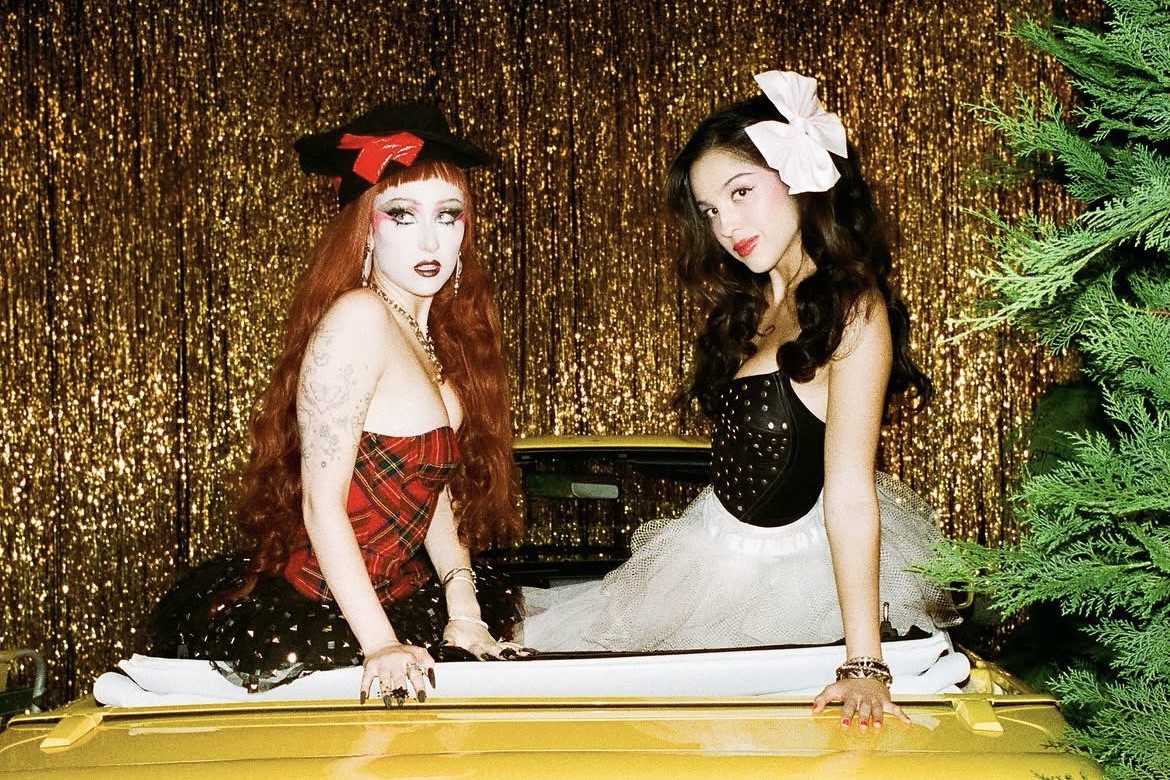
Olivia Rodrigo and Chappell Roan’s “expectations” remix video has sparked an online debate over its animated sequences, with some viewers questioning whether artificial intelligence was used to create them. However, the visual’s distorted hands and exaggerated movements are consistent with traditional animation techniques, while Olivia Rodrigo has recently reiterated her firm opposition to using AI in her music.
Directed by Bardia Zeinali, the video transforms the collaboration into The Big Expectations Show, a campy parody of 1980s and 1990s television game shows. Rodrigo and Roan appear as contestants, David Byrne plays host Johnny Johnson, and the production features appearances from Rodrigo’s longtime collaborator Dan Nigro and drag performer Aquaria. Retro sets, elaborate costumes, VHS-inspired effects, and animated interludes complete the deliberately exaggerated aesthetic.
Your daily dose of music news, trends, and fresh drops.
InMusic Newsletter
The controversy emerged after screenshots of the cartoon sequences circulated online, with critics pointing to what they described as potential AI-generated errors. The examples included hands with apparently inconsistent finger counts, distorted limbs, and features that seemed to change between frames, prompting accusations that the production contradicted Rodrigo’s public stance on artificial intelligence.
Those apparent imperfections, however, have a longstanding explanation in traditional animation: smear frames. Used by animators for decades, the technique involves deliberately stretching, duplicating, or distorting a character’s body for a fraction of a second to communicate rapid movement. Rather than maintaining anatomically accurate proportions in every frame, artists exaggerate the motion so that an action feels faster and more fluid when played at normal speed.
The technique has a rich history in hand-drawn animation, from early cartoon pioneers to the work of Warner Bros. directors Tex Avery and Chuck Jones. Similar visual distortions can be found throughout Looney Tunes, Disney productions, and The Simpsons. A hand that appears to have missing fingers or an arm that briefly looks misshapen can therefore be an intentional artistic choice rather than evidence of generative AI. Isolating a single frame removes the movement that makes the effect work, leaving behind an image that can look strangely artificial.
The broader production also provides context for the debate. The video combines live-action performances, physical sets, costume changes, and a cast that includes Byrne, whose appearance as the fictional host helps establish the retro television concept. Zeinali has directed music videos for major pop artists, including Sabrina Carpenter and Tate McRae. The presence of animated sequences alone does not establish how they were produced, and no production evidence provided for the allegations confirms that generative AI was responsible.
Olivia Rodrigo’s own comments have added another dimension to the discussion. In a recent interview with The Hollywood Reporter, she was unequivocal when asked about using artificial intelligence in her music: “Absolutely no. Hard line on that.” She recalled joking with Nigro about asking ChatGPT for Olivia Rodrigo song-title ideas, only to find the suggestions “all f-cking awful.” Her remarks reinforce her stated position on AI-assisted music, although they do not independently establish the production methods used for every element of the video.


Leave a Reply